

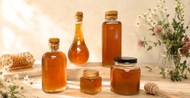
Glass Honey Jars and Bottles: A Wholesale Packaging Guide
Choosing glass packaging for honey comes down to three decisions: fill size, mouth width, and closure compatibility. Honey's viscosity makes those decisions different from packaging a thin liquid — a narrow bottle that suits a pourable varietal can slow a filling line, while a wide-mouth jar that fills cleanly may not suit a product meant to be poured. This guide explains how honey packers, gourmet food brands, and co-packers can compare glass jars and bottles, choose sizes that support a full retail line, and identify which closures work with each glass finish.
Quick Answer
The best glass container for honey depends on how the product is used. Wide-mouth jars suit spoonable, raw, and crystallizing honey; narrower bottles suit pourable and infused varieties. Glassnow supplies wholesale glass jars and bottles for honey producers in sampler, retail, and large-format sizes, with compatible corks, screw caps, bamboo lids, and accessories.
Why glass works for honey packaging
Glass is impermeable to moisture and gases. For a hygroscopic product like honey, where moisture content is an important consideration, glass provides a strong barrier between the product and the surrounding environment.
Glass is also visually neutral. Honey's color runs from water white through dark amber, and that color is often the clearest signal of floral source and grade. Clear glass puts that difference on the shelf without a label having to explain it.
Glass is a recyclable packaging material, which matters to buyers building a product line around sourcing and sustainability positioning. Glass is also a rigid packaging material that maintains its shape during storage and display, supporting a consistent shelf presentation across a product line.
What should honey producers consider when sourcing glass containers?
U.S. honey production in 2025 totaled 116 million pounds, down 14 percent from the year before, from 2.41 million honey-producing colonies — itself down 7 percent. Over the same period, average prices rose 27 percent to $3.05 per pound. With honey production and pricing changing year to year, producers also need to think carefully about portion size, retail positioning, and packaging costs.
Practical criteria to compare:
- Fill weight versus container volume. Honey is denser than water, so a container's fluid-ounce rating and its net weight in honey are not the same number. Confirm both before committing to a label claim.
- Mouth width. This drives filling speed, ease of dispensing, and how the consumer gets the last of the product out.
- Closure compatibility. Cork-finish and threaded containers are not interchangeable. A threaded container needs a screw cap in the same thread finish; a cork-finish container needs a correctly sized cork.
- Liner type. Screw caps are offered with either a plastisol or a PE liner. The liner is part of the closure specification and worth confirming for a viscous fill.
- Label panel. Square and rectangular containers give flat, uninterrupted label real estate; round containers wrap.
- Case quantity and reorder cadence. Seasonal harvests mean uneven demand — check case counts against your expected run size.
- Line consistency. If you plan to release varietals, infused honey, or gift sets, choose a shape available across several sizes so the line reads as one family.
Glass jars versus glass bottles for honey
This is the first real decision, and it follows from how the product is meant to be used.
Glass jars suit spoonable honey — raw, creamed, comb, and any honey likely to crystallize. A wide opening lets a spoon reach the bottom and makes crystallized product recoverable rather than stranded. The wider opening can also make filling and neck cleanup easier, particularly for thicker honey, while helping minimize product residue around the opening before the container reaches the shelf. For gift and specialty presentation, a jar accommodates a cork lid and a bamboo or wooden spoon.
Glass bottles suit pourable honey — lighter varietals, infused honey, and honey blended for foodservice or beverage use. A taller silhouette reads differently on shelf and merchandises alongside syrups, oils, and vinegars. Bottles also support pour control, either through the neck geometry itself or through a compatible pourer.
Many brands run both. A jar for the flagship raw honey and a bottle for an infused or lighter varietal lets a single line cover two distinct use cases without a second visual identity.
One structural advantage worth knowing: several Glassnow shapes exist in both a threaded and a cork-finish version — the Apothecary and Orleans Square silhouettes among them. A brand can hold one shape across a collection and still choose the closure format SKU by SKU.
What sizes work for a honey line?
Most honey lines resolve into three tiers.
Sampler and portion sizes (roughly 1–3 oz). Used for market samples, buyer and trade-show testers, gift-set components, and multi-varietal tasting flights. The 1.2 oz Honey Pot (6108) and the 1.2 oz Octagonal Glass Jar (6126) both take agglomerated cork closures, and the octagonal jar's multi-panel shape gives a flat surface for small-format labeling.
Retail core (8–16 oz). The bulk of shelf volume. The 8 oz Apothecary Glass Jar is available threaded in a 58/400 finish (5145) and in a cork finish (6145), so a brand can run one silhouette and choose the closure format per SKU. Both hold roughly 12 oz of honey by weight at an 8 oz volume rating. The 8.5 oz Glass Jar with Cork and Spoon (6122-C) ships with a glass handle that holds a bamboo spoon, making it a complete presentation for gift and market channels.
For square-footprint shelf efficiency and flat label panels, the Orleans Square is a modern take on the French Square and Muth jar formats long associated with honey. It comes in 8 oz and 16 oz threaded 43/400 versions, and in 8 oz and 16 oz cork-finish versions — 12 oz and 24 oz honey weight respectively.
On the bottle side of this tier, the 9 oz Apothecary Glass Bottle (5527) offers a wider 43/400 mouth than a standard 28/410 bottle neck, which keeps filling manageable without giving up the taller bottle silhouette. A cork-finish version (6527) is also available. The 13 oz Calypso Wide Mouth Glass Jar (5193) rounds out the upper end of the tier.
Large format and foodservice (16–25.4 oz). For thick, raw, or crystallizing honey at volume, the 16 oz Calypso Wide Mouth Glass Jar (5192) uses an 89/400 finish — the widest opening in the range, providing generous access for filling and dispensing thick, raw, or crystallizing honey. The 16 oz Wide Mouth Roma Glass Bottle (5053) and the 25.4 oz Apothecary Glass Bottle, threaded (5532) or cork-finish (6532), cover large-format retail and foodservice fills.
Buyers comparing sizes and finishes can browse Glassnow's honey and syrup containers to see the full range side by side.
Which closures work with honey jars and bottles?
Closure choice is a compatibility question before it is a design question. Compatibility narrows the field to what physically fits; four factors then decide among what's left.
- Sales channel. Cork closures read gift-forward and suit farmers markets, gift sets, and specialty retail. Screw caps read functional and suit grocery shelves, subscription boxes, and foodservice. Match the closure to where the product actually sells, not to the photograph.
- Filling and capping method. Corks are inserted individually. Screw caps suit higher-volume capping and more consistent torque across a run. If you are scaling from hand-filling to a line, the closure format is part of that decision.
- How often the consumer reopens it. A jar of raw honey gets opened daily and needs a closure that reseals easily and cleanly. A gift or sampler size opened a few times can prioritize presentation.
- Tamper evidence. Cork closures do not show tampering on their own. If your channel requires a tamper-evident seal, plan for a shrink band as part of the closure spec rather than an afterthought.
Whichever direction you take, test closures with your actual product before committing to a bulk order. Fill viscosity, temperature, and headspace all affect how a closure seats, and Glassnow recommends testing corks, caps, and closures prior to ordering in volume.
Thread finish sizes. A designation like 58/400 describes the closure size and thread configuration: the first number is the approximate opening diameter in millimeters, the second describes the thread style. Honey containers in the Glassnow range commonly use 43/400, 58/400, and 89/400 finishes. A compatible screw cap must share the same designation.
Liners. Screw caps are stocked with either a plastisol or a PE liner, in finishes including black and white tinplate, aluminum, and PP plastic. Confirm which liner suits your fill and process.
Accessories. Bamboo wood spoons in 3.5" and 4.5" lengths pair with wide-mouth jars for gift and market presentation. A stainless steel pourer suits bottled honey and syrup. Shrink bands in clear and black are stocked across a range of diameters and heights for tamper-evident sealing.
Custom honey packaging
Glassnow offers screen printing, custom glass design, and bamboo laser burning. Screen printing applies artwork directly to the glass in rich colors, metallics, or organic inks — a way to brand the container without a paper label covering the honey. Custom glass design produces a mold specific to your line.
Submit a customization request with your specifications and the Glassnow team will follow up with a quote.
Stock glass carries a lot of honey brands a long way. A distinctive label on a well-chosen container establishes a line on shelf, and customization can be layered in as the range grows.
Frequently asked questions
What size glass jar is best for honey packaging? Most retail honey lines center on 8 oz to 16 oz containers, with 1–3 oz sizes for samples and gift sets and 16–25 oz sizes for large-format or foodservice fills. Because honey is denser than water, confirm the net weight your chosen container holds rather than relying on its fluid-ounce rating alone.
Do honey jars need a wide mouth? Not always, but a wider mouth helps with thick, raw, and crystallizing honey. It speeds filling, makes the product easier to spoon out, and reduces residue left in the container. Pourable and infused honey works well in narrower bottles.
What closures are compatible with glass honey jars and bottles? That depends on the container's finish. Cork-finish containers take tapered or T-corks sized to the opening. Threaded containers take screw caps in the same thread designation — 43/400, 58/400, 70/450, or 89/400, depending on the container. Bamboo lids are available for select wide-mouth jars.
Is glass or plastic better for honey packaging? Glass is non-porous, does not absorb or transfer odors, displays honey color clearly, and is recyclable. For brands selling on varietal distinction, provenance, or shelf presence, glass supports the positioning in a way plastic generally does not.
What does 58/400 mean on a honey jar? It is a closure specification. The first number is the approximate opening diameter in millimeters. The second describes the thread configuration. A cap must match both numbers to thread correctly.
Can honey containers be customized for a brand? Yes. Screen printing, custom color, and custom glass design are available at larger order volumes — custom glass minimums start around 50,000 units, custom accessories around 25,000 units. Many brands begin with stock glass and a distinctive label before moving to custom.
Sourcing wholesale honey packaging
Glassnow is a wholesale glass packaging supplier serving gourmet food producers, honey packers, and specialty food brands. The range covers glass jars and bottles in cork-finish and threaded formats, along with compatible corks, screw caps, bamboo lids, spoons, pourers, and shrink bands — so a full honey line can be sourced from one supplier.
Explore honey and syrup containers, or compare cork-finish glass jars and threaded glass jars by size and finish. For guidance on larger-volume projects, contact the Glassnow team.
Industry data: USDA National Agricultural Statistics Service, Honey, released March 2026. Additional honey research and marketing resources are available from the National Honey Board.